Feminist Solutions for Ending War by Megan MacKenzie Nicole Wegner
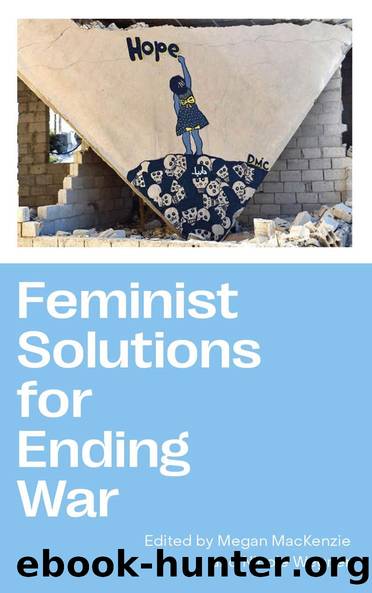
Author:Megan MacKenzie, Nicole Wegner [Megan MacKenzie, Nicole Wegner]
Language: eng
Format: epub
ISBN: 9780745342870
Barnesnoble:
Goodreads: 57550101
Publisher: Pluto Press
Published: 2021-11-20T00:00:00+00:00
8
Make Foreign Policies as if Black and Brown Lives Mattered
Yolande Bouka
So make no mistake, because we acted quickly, a humanitarian catastrophe has been avoided and the lives of countless civilians â innocent men, women and children â have been saved.
President Barack Obama on the military
intervention in Syria (2011 weekly radio address)
This chapter argues that to end wars, we need to reimagine the world as one where Black and Brown peopleâs lives matter. In this vision, racialised groupsâ vulnerabilities to, and experiences with, physical and structural violence would inform foreign policies when evaluating cost and benefits of war and military interventions. Reimagining this world is not a project of science fiction. It is a necessary endeavour for which Black feminist thought, anti-colonial scholarship, and Feminist International Relations scholars have laid the foundations. Grounding foreign policy in these theoretical traditions has the potential to help us rethink war, promote peace, and preserve human dignity.
There are multiple ways to reimagine a world in which Black and Brown lives matter. This chapter imagines such a world by asking readers to challenge current justifications for war. Too often, military interventions are waged in the name of civilian protection and promotion of democracy. These claims obscure the underlying foreign policy priorities of political and military elites. Military interventions place racialised and vulnerable groups at a disproportionate risk of extreme and long-term violence. This chapter argues that in order to end war, we must not only pay attention to the circumstances in which militarised interventions are deployed but must also interrogate the gendered and racialised implications of moral justifications of war. We must critically assess the reasons for intervening, the rules of engagement on the ground, and the type of peace-building strategies used for, on, and against Black, Brown, or otherwise racialised people.
This chapter foregrounds feminist and anti-colonial approaches to examine contemporary military interventions as a continuation of masculine, colonial and imperial projects. First, it seeks to demonstrate the global hierarchy where human lives are valued based on where they are situated along the colour line. I ask why and how powerful states choose to intervene in the name of the âresponsibility to protectâ (R2P) when, for the most part, civilians in zones of interventions end up suffering disproportionately from the direct and indirect impacts of war. Second, this chapter seeks to illustrate how gendered protection discourses and practices used to legitimate war and interventions obscure how women and girls are disproportionately burdened by militarised responses to threats. Ending war requires us to see the connection between war, colonial logic, and masculine logics of militarisation.
In this chapter, I use W.E.B. Du Boisâ conceptualisation of racism as a root of war and echo Sojourner Truthâs provocation that Black women (and other women of colour) do not benefit from the same level of protection as their white counterparts in military interventions. I also draw on Black feminist theory, including Kimberlé Crenshawâs concept of intersectionality. Black feminist thought has helped illuminate the deep and layered forms of insecurity that Black and Brown men, women and children face before, during and after war.
Download
This site does not store any files on its server. We only index and link to content provided by other sites. Please contact the content providers to delete copyright contents if any and email us, we'll remove relevant links or contents immediately.
| Arms Control | Diplomacy |
| Security | Trades & Tariffs |
| Treaties | African |
| Asian | Australian & Oceanian |
| Canadian | Caribbean & Latin American |
| European | Middle Eastern |
| Russian & Former Soviet Union |
The Secret History by Donna Tartt(19088)
The Social Justice Warrior Handbook by Lisa De Pasquale(12190)
Thirteen Reasons Why by Jay Asher(8910)
This Is How You Lose Her by Junot Diaz(6887)
Weapons of Math Destruction by Cathy O'Neil(6280)
Zero to One by Peter Thiel(5802)
Beartown by Fredrik Backman(5754)
The Myth of the Strong Leader by Archie Brown(5507)
The Fire Next Time by James Baldwin(5446)
How Democracies Die by Steven Levitsky & Daniel Ziblatt(5219)
Promise Me, Dad by Joe Biden(5153)
Stone's Rules by Roger Stone(5088)
A Higher Loyalty: Truth, Lies, and Leadership by James Comey(4964)
100 Deadly Skills by Clint Emerson(4925)
Rise and Kill First by Ronen Bergman(4789)
Secrecy World by Jake Bernstein(4753)
The David Icke Guide to the Global Conspiracy (and how to end it) by David Icke(4720)
The Farm by Tom Rob Smith(4513)
The Doomsday Machine by Daniel Ellsberg(4490)
